
Artificial Intelligence (AI) is transforming the way we live, work, and communicate. From personalized recommendations on streaming platforms to voice assistants and self-driving cars, AI is becoming an essential part of everyday life. At the heart of many of these intelligent systems are machine learning and neural networks. But how do neural networks power machine learning, and why are they considered the driving force behind modern AI? Let’s explore.
What Is Machine Learning?
Machine learning is a branch of artificial intelligence that enables computers to learn from data instead of relying solely on predefined instructions. Rather than programming every possible scenario, developers train machine learning models using large datasets. These models identify patterns, make predictions, and improve their performance over time as they process more information.
Machine learning is widely used in spam email detection, online shopping recommendations, fraud detection, healthcare diagnostics, and language translation. Its ability to learn and adapt makes it one of the most valuable technologies in today’s digital world.
What Are Neural Networks?
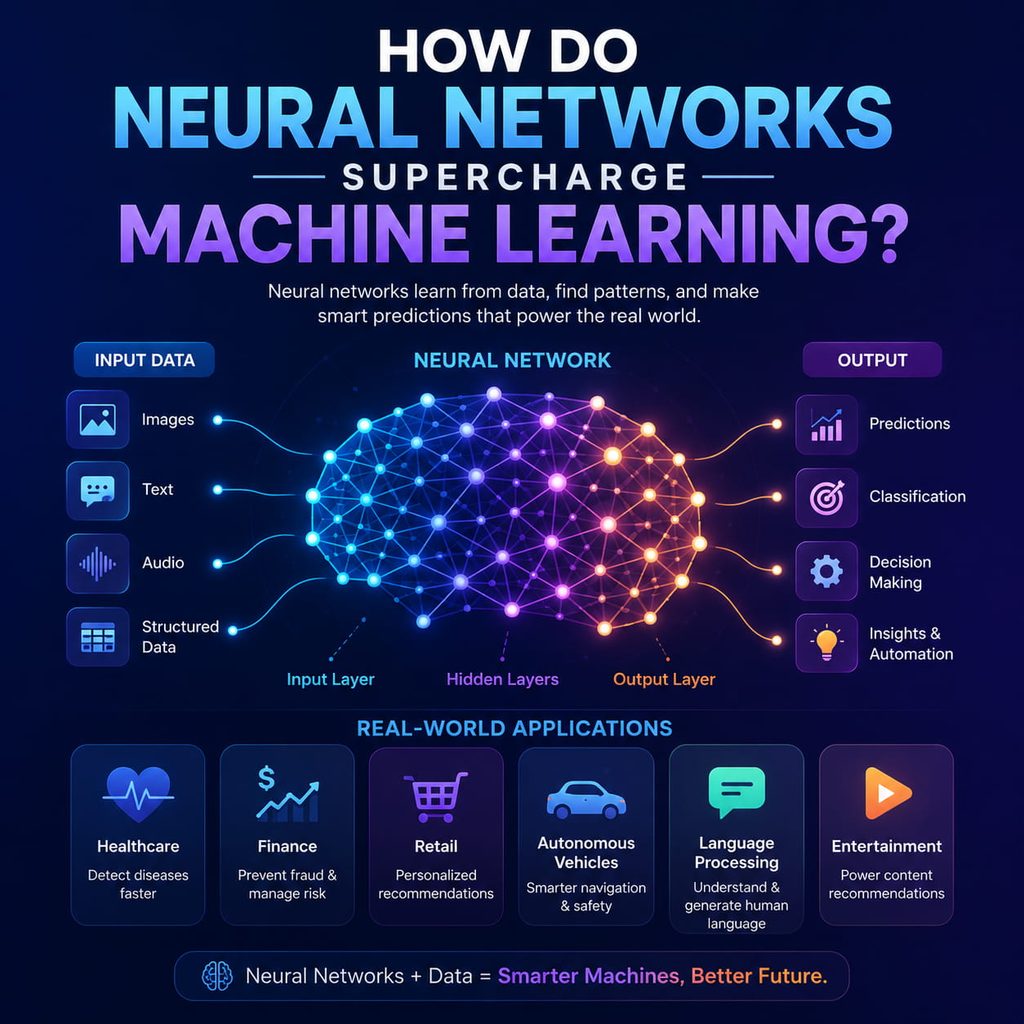
Neural networks are a type of machine learning model inspired by the structure of the human brain. They consist of interconnected layers of artificial neurons that process information and learn from data. Each neuron receives input, performs calculations, and passes the result to the next layer until the network produces an output.
Unlike traditional machine learning algorithms that often require manual feature selection, neural networks can automatically discover patterns within complex datasets. This capability makes them especially effective for solving problems involving images, speech, videos, and natural language.
How Do Neural Networks Power Machine Learning?
Neural networks power machine learning by enabling computers to recognize patterns, learn from experience, and make intelligent decisions with minimal human intervention. During training, the network compares its predictions with the correct answers and adjusts its internal parameters to reduce errors. This process, repeated thousands or even millions of times, allows the model to become increasingly accurate.
For example, when a neural network is trained to recognize cats in images, it first learns simple features such as edges and shapes. As training continues, it begins identifying ears, eyes, whiskers, and eventually the complete image of a cat. This layered learning process allows neural networks to solve tasks that are difficult for traditional algorithms.
Real-World Applications
Neural networks are transforming numerous industries by making technology smarter and more efficient. In healthcare, they help detect diseases from medical images and assist doctors in making faster diagnoses. In finance, they identify fraudulent transactions and assess financial risks. Retail businesses use them to recommend products based on customer preferences, while automotive companies rely on neural networks to support autonomous driving systems.
They also power virtual assistants, facial recognition, language translation, chatbots, and content recommendation systems used by millions of people every day.
Benefits and Challenges
One of the greatest advantages of neural networks is their ability to learn automatically from massive amounts of data. They deliver high accuracy, adapt to new information, and perform exceptionally well on complex tasks that involve images, audio, and text.
However, neural networks also have limitations. They require significant computing power, large datasets, and considerable training time. Additionally, their decision-making process can be difficult to interpret, making them less transparent than some traditional machine learning methods.
Conclusion
Neural networks are the technology that powers many of today’s most advanced machine learning systems. By learning patterns directly from data, they enable computers to recognize images, understand language, predict outcomes, and solve complex problems with remarkable accuracy. As artificial intelligence continues to evolve, neural networks will play an even greater role in shaping the future of healthcare, education, finance, transportation, and countless other industries. Understanding how neural networks power machine learning not only helps us appreciate today’s AI innovations but also prepares us for a future where intelligent systems become an even bigger part of our daily lives.
Subscribe to us on YouTube to learn more.